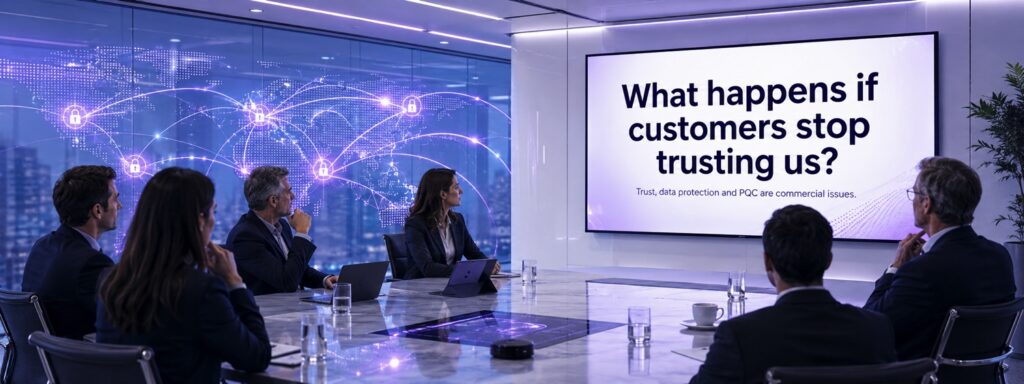
Most companies say customer trust matters.
Fewer can say how much revenue, valuation, and future growth depends on it.
That is the question boards should be asking now:
If customers stopped trusting us with their data, systems, or operations, what would happen to the business?
For many organisations, the answer is not “some inconvenience.”
It is severe commercial damage.
Customers no longer buy only products or services. They hand over access, information, workflows, credentials, transaction histories, intellectual property, customer records, and operational dependency. In many sectors, a supplier is not just a vendor. It is part of the customer’s business infrastructure.
That makes trust more than a brand value.
Trust is commercial infrastructure.
When it breaks, the consequences are immediate and measurable: lost renewals, cancelled contracts, procurement blocks, emergency audits, regulatory investigations, class actions, insurance disputes, board scrutiny, valuation pressure, and competitors arriving with a stronger security story.
The commercial chain is brutally simple:
Lost data becomes lost trust.
Lost trust becomes lost customers.
Lost customers become lost revenue.
Lost revenue becomes lost enterprise value.
That is why cyber risk, data protection, and post-quantum cryptography readiness must now be discussed in business language — not only technical language.

Where the Risk Becomes Commercial
(or why does it matter?)
The risk is most acute when an organisation holds information or access that affects the customer’s own value, legal position, continuity, or reputation.
Consider six practical scenarios:
1. You hold customer intellectual property.
Product designs. Source code. Engineering files. Research documents. Pricing models. M&A plans. Customer lists. Commercial strategy.
To the customer, this is not “data.” It is future revenue. If it is exposed or silently copied, years of investment can be weakened in a single breach. The technical incident may be contained in weeks. The commercial damage may last for years.
2. You hold legally sensitive records.
Contracts. Dispute files. Investigation material. Board papers. Compliance reports. Privileged communications.
A breach here can do more than expose information. It can weaken a customer’s legal position, reveal strategy, compromise confidentiality, and create reputational harm. If your platform was marketed as secure or suitable for sensitive material, your own claims will be examined closely.
3. You hold financial history.
Payment records. Bank details. Tax data. Payroll files. Credit histories. Transaction records. Insurance information.
Customers may forgive an operational delay. They rarely forgive financial exposure. Fraud, identity theft, account takeover, and targeted scams can continue long after the incident response closes. The company may think the breach is over. The customer does not.
4. Your software touches customer facilities or operations.
Building access. Logistics. Healthcare infrastructure. Smart devices. Industrial systems. Energy, transport, or manufacturing environments.
In this scenario, compromise can move from digital harm to physical disruption. Theft, safety incidents, sabotage, loss of operational control, and immediate contract termination become realistic outcomes.
The board-level question is simple:
Are we providing a service, or are we part of the customer’s security perimeter?
5. Your SaaS manages customer workflows.
Orders. Bookings. Payments. Inventory. Sales pipelines. Case management. Scheduling. Approvals. Delivery operations.
Here, customers trust not only confidentiality. They trust accuracy and availability. They trust that the order is real, the payment instruction is valid, the approval is genuine, and the pipeline has not been manipulated.
Once that trust is broken, the customer may have no choice but to move.
Not because they want to.
Because their own continuity depends on it.
6. You store your customers’ customer data.
This is one of the most dangerous positions commercially.
You are holding second-order trust. Your customer has promised their own clients, patients, tenants, members, users, or account holders that their information is safe. If your breach exposes that data, your customer is embarrassed in front of its own market.
The result is a chain reaction: your failure damages your customer; your customer’s damaged reputation harms their customer relationships; that commercial injury returns to you through litigation, indemnity claims, contract termination, and loss of market confidence.
Class Actions Turn Trust Failure into Financial Pressure
A class action does not simply ask, “Was data exposed?”
It asks harder questions.
Did the company know what it held?
Did it understand the harm exposure could cause?
Were controls appropriate?
Was encryption adequate?
Were legacy systems managed?
Were vendors assessed?
Were warnings ignored?
Was the board aware?
The legal process can expose a more damaging story than the breach itself: that leadership knew more than it acted on, that security was underfunded, that customer data was over-collected, that old systems were left vulnerable, or that trust was treated as a marketing message rather than an operational obligation.
For boards, this is the real issue.
Cyber incidents are no longer judged only by what happened. They are judged by what the organisation could reasonably have foreseen — and what it did before the damage arrived.
Why Post-Quantum Risk Changes the Timeline
Post-quantum computing introduces a different kind of risk.
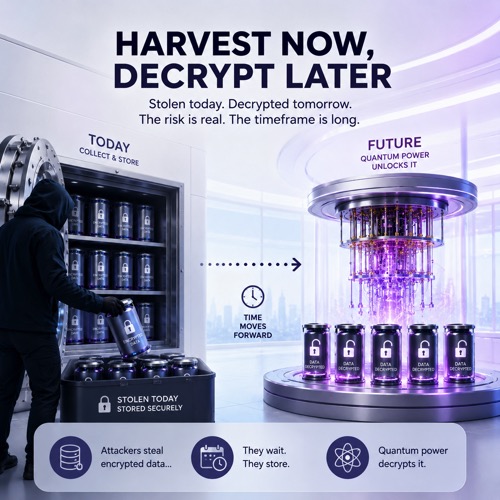
An attacker may not need to decrypt stolen information today. They can capture encrypted data now and decrypt it later when quantum capabilities mature. This is often described as “harvest now, decrypt later.”
That matters wherever data stays sensitive for years: identity records, legal files, health information, financial histories, intellectual property, government-related records, infrastructure data, authentication credentials, confidential contracts, and executive communications.
For companies holding this kind of information, PQC readiness is not a future technology project.
It is current risk management.
Because the breach may happen today.
The damage may arrive later.
And the future question from customers, regulators, insurers, courts, and investors may be painfully direct:
Why did you wait?
The Board Test
Every leadership team should be able to answer these questions:
- What sensitive customer data do we hold?
- Which customers depend on us for operational continuity?
- Do our systems provide access to customer facilities, workflows, pipelines, or infrastructure?
- Do we store our customers’ customer data?
- Which data would create legal, financial, or reputational harm if exposed?
- Which systems rely on encryption that may become vulnerable in the post-quantum era?
- Can we prove we are taking reasonable steps now?
These are not technical questions.
They are trust questions.
And trust questions belong with the board.
What Readiness Should Look Like
PQC readiness does not start with panic. It starts with visibility.
Boards and executive teams need a clear view of where sensitive data sits, how long it remains valuable, which systems protect it, which vendors handle it, and where encryption is embedded across applications, platforms, integrations, and infrastructure.
That requires practical work: system mapping, data classification, cryptographic inventory, vendor review, migration planning, secure architecture, and a roadmap that aligns technology decisions with commercial risk.
This is where Ariadne Thread Solutions helps organisations move from uncertainty to action.
We work with businesses that need custom software that means that they need create something new, fix what what was working before and stopped and probably attend to do what never was done before. Post-quantum readiness hits all three qualities – we are here to help.
Our role on planning stage is to connect the board-level risk with the operational reality: what systems exist, what data they hold, where trust could break, and what needs to change before exposure becomes liability.
The next stages are to be decided – based on the information gathered during assessments and planning.
The Real Conclusion
A business dependent on customer trust cannot treat data protection as a back-office function.
If you hold sensitive customer data, you hold part of the customer’s business value.
If your SaaS connects to customer operations, you are part of their continuity model.
If you store their customer data, you are part of their reputation.
If your systems provide access to their facilities, you are part of their security perimeter.
And if that trust breaks, the consequences do not stop at incident response. They move into lost customers, class actions, damaged reputation, reduced valuation, regulatory scrutiny, and market distrust.
This is why PQC readiness matters.
Not as a theoretical cryptography exercise.
Not as a compliance box.
But as a practical step in protecting customer trust before the next generation of threats turns today’s encrypted data into tomorrow’s exposed liability.
The companies that act early will have a stronger story to tell customers, regulators, insurers, investors, and courts.
The companies that wait may discover that the most expensive thing they lost was not the data.
It was the trust that made the business valuable.